
CONFIRMED: Google is replacing Wikipedia Knowledge Panels with AI
Begun, the enshittification of knowledge panels has

Face front, true believers! Wikify is back with what might be our finest installment yet. First up, we explore how Google is using AI to generate the text that appears in knowledge panels for celebrities. That text was previously pulled directly from Wikipedia, which is now one of several cited sources—including Britannica, clickbait websites, and ChatGPT-generated slop. Yes, that means AI is now summarizing other AI content, and the results aren't great!
We then introduce a new Wikify segment: Wikipedia in the News, where we rundown prominent media coverage (including an intriguing article titled "Was Wikipedia manipulated as part of the Blake Lively smear campaign?") and offer our own analysis. And our final section covers an evergreen topic: How does a brand or CEO qualify for a Wikipedia article? (Spoiler alert: Crypto donations to the Wikimedia Foundation aren't allowed and won't help your case.)
Buckle up, buckaroos. This one's a doozy!
Celebrity knowledge panels get an AI glow-up
Over the last few weeks, we've noticed that Google has been using AI to create the "Overview" copy for celebrity knowledge panels—and the results are alarming, as Google is pulling data from clickbait websites and ChatGPT-generated slop to generate what should be factual career summaries. The AI overview is currently limited to actors, artists, directors, musicians, etc. A rollout to other categories seems inevitable, though, and could quickly generate glaring errors across all search results.
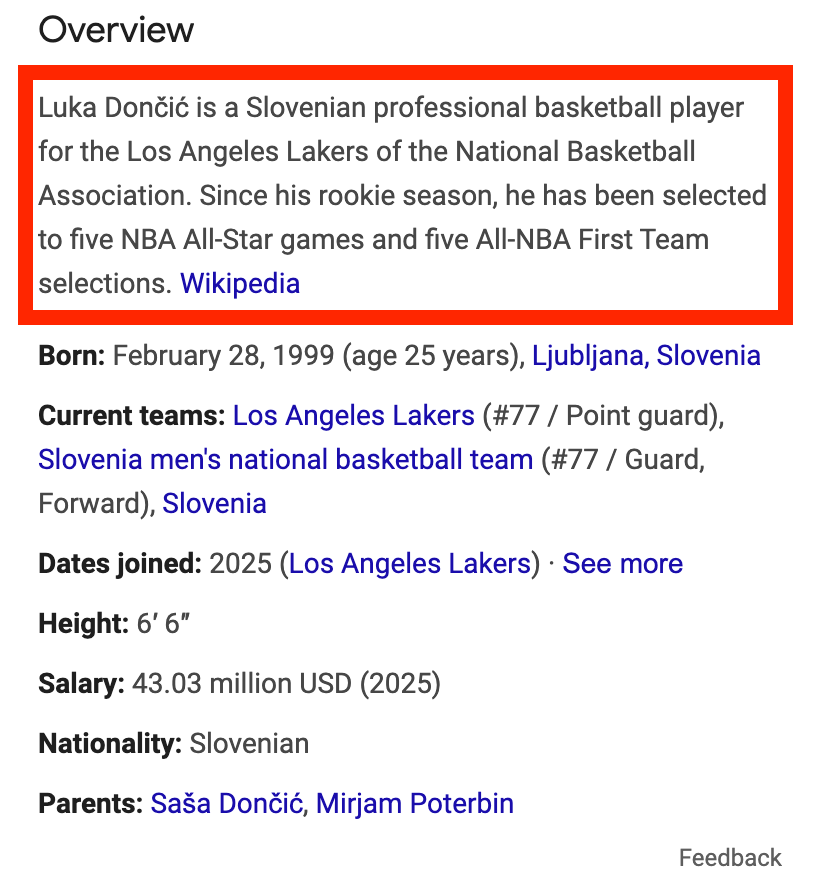
Knowledge panels, as you'll recall, are the information boxes that appear to the right of (and occasionally above) organic results when you search for prominent people, places, organizations, and things. The overview copy within knowledge panels is often pulled directly from Wikipedia, which is then cited as a source. The knowledge panel for NBA player Luka Dončić is a good example of this:
For celebrity knowledge panels, though, Google now cites multiple sources and then uses AI to create a brief summary. You can see this with the knowledge panel for Severance star Patricia Arquette:
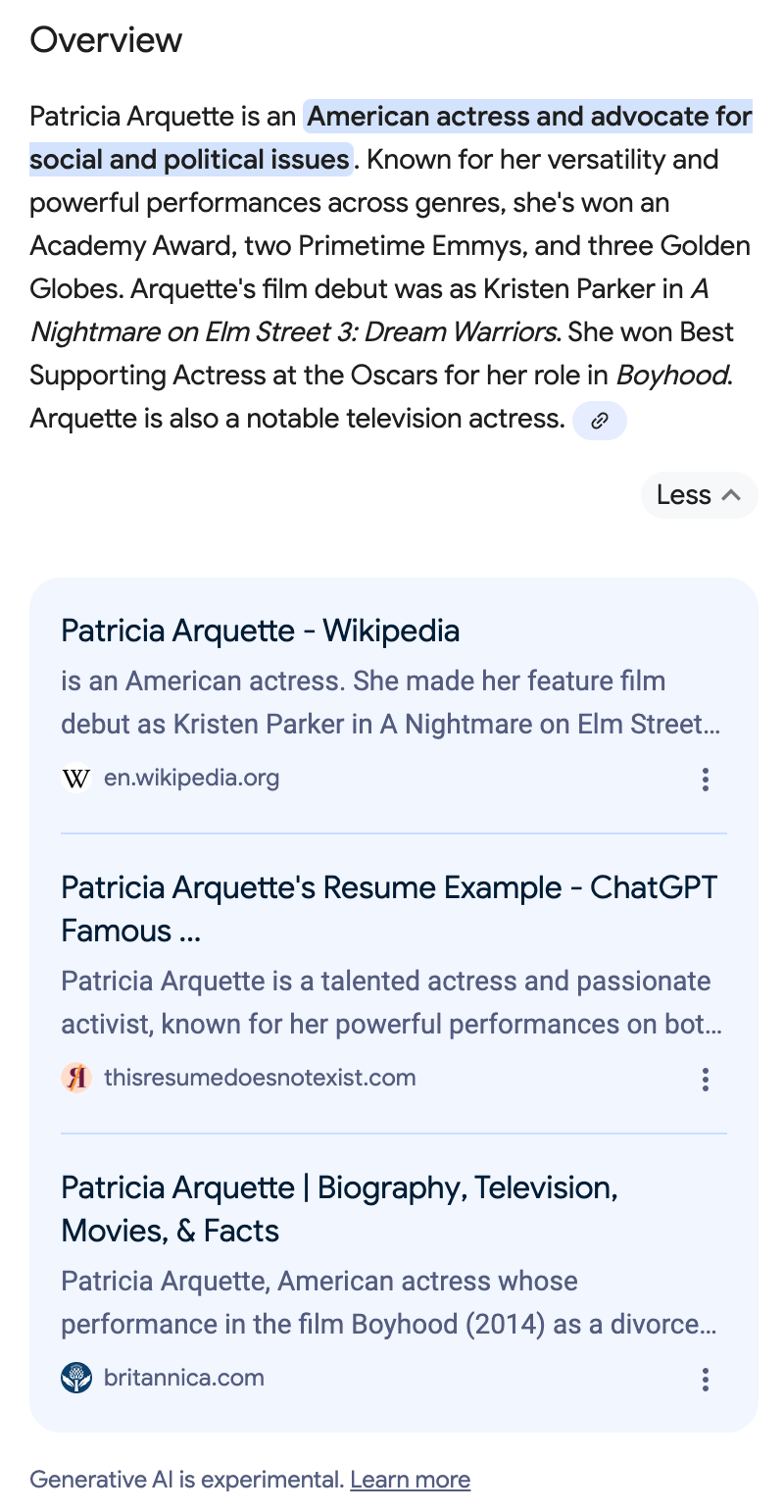
Wikipedia remains one of the cited sources, but the other two are Patricia Artquette's Encyclopedia Britannica article, and… a totally random profile of Artquette created by ChatGPT and hosted on a site called ThisResumeDoesNotExist. These three citations are followed by a disclaimer: "Generative AI is experimental."
The overall change in copy isn't that significant, but there's a clear change in length and tone. When Google pulls knowledge panel language from Wikipedia (like for the Dončić example), it typically only includes the first two sentences from the cited article. So Arquette's overview previously would have looked like this:
Patricia Arquette is an American actress. She made her feature film debut as Kristen Parker in A Nightmare on Elm Street 3: Dream Warriors (1987) and has since received several awards, including an Academy Award, two Primetime Emmy Awards, and three Golden Globe Awards.
Compare that with how the overview copy reads now:
Patricia Arquette is an American actress and advocate for social and political issues. Known for her versatility and powerful performances across genres, she's won an Academy Award, two Primetime Emmys, and three Golden Globes. Arquette's film debut was as Kristen Parker in A Nightmare on Elm Street 3: Dream Warriors. She won Best Supporting Actress at the Oscars for her role in Boyhood. Arquette is also a notable television actress.
The AI version is far longer and considerably more… flowery. The claim that Arquette is "known for her versatility and powerful performances" is certainly correct, but it's not the kind of language you would find on Wikipedia unless attributed to a specific critic. In this case, the effusive praise reflects the cited ChatGPT-generated profile, which includes passages like "She has portrayed a variety of roles with equal skill, and her acting range is quite astounding."
Right now we're only seeing these AI-generated knowledge panel overviews for celebrities, but we wouldn't be surprised if the AI glow-up treatment isn't soon rolled out to other knowledge panel categories.
And that would be a big, big, big deal.
Until now, Google has basically outsourced editorial decision-making about how to describe prominent subjects to Wikipedia. If it's now going to rely on AI to summarize from multiple sources, then it's suddenly Google itself (read: Alphabet, Inc.) responsible for the content's neutrality and accuracy. And there's certainly reason to suspect this process could go awry!
As the Arquette example demonstrates, Google's AI is making some pretty poor choices about what constitutes a reliable source. A website that looks like this should never ever, ever, ever, ever be appearing as a citation in a knowledge panel:
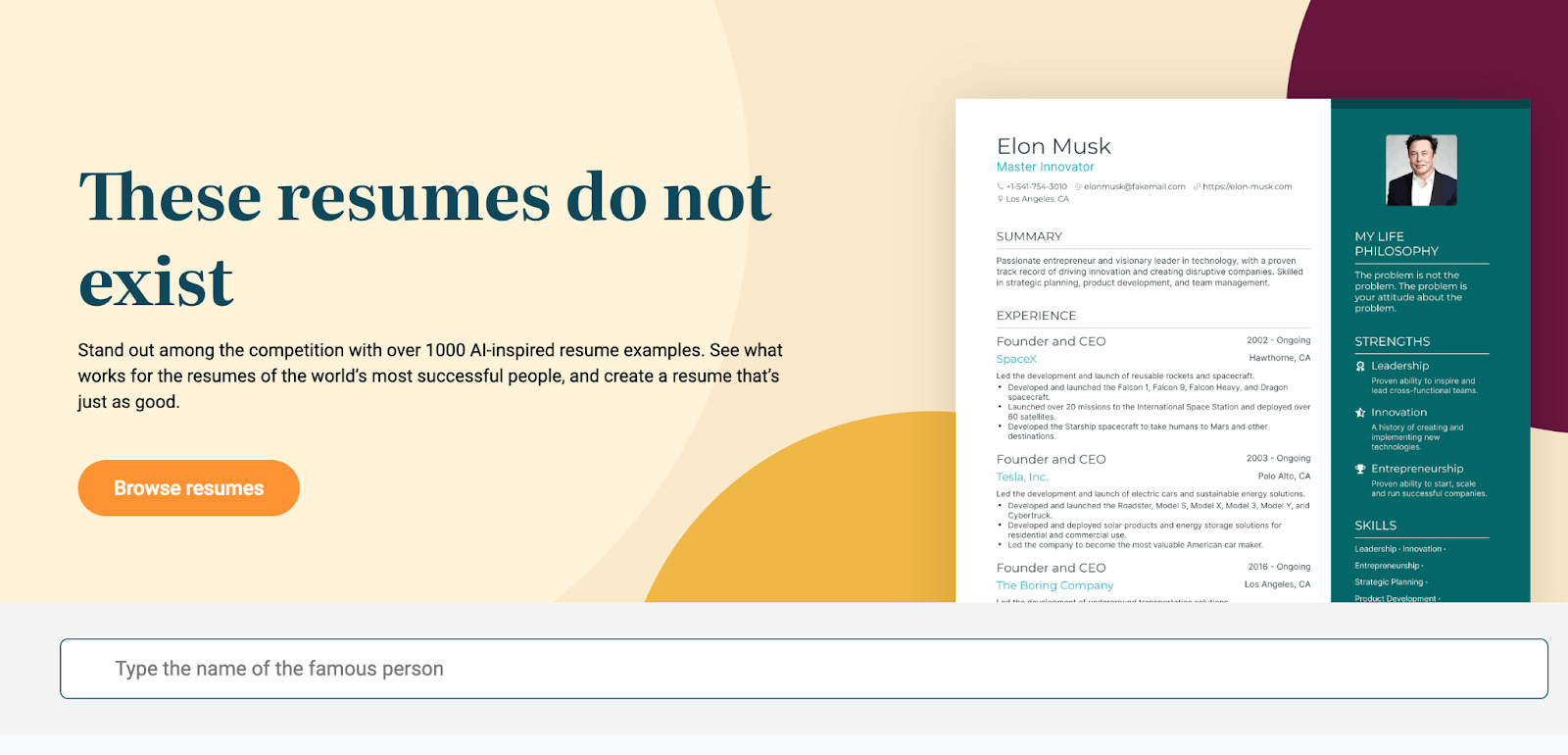
And this isn't a one-off error. The knowledge panel overviews for Brad Pitt, Steven Spielberg, and countless other celebrities pull from clickbait sites as well.
This is an issue that Wikify will be watching closely. Please email us if you find examples of especially poor AI-generated overviews.
Wikipedia in the news
Was Wikipedia manipulated as part of the Blake Lively smear campaign? (D. F. Lovett)
Writer D. F. Lovett makes the case. (We're not convinced, but we will always support someone passionately doing their own research on the internet. What could go wrong!)
Wikipedia Prepares for 'Increase in Threats' to US Editors From Musk and His Allies (404 Media)
Great reporting from Jason Koebler. As we noted in our last installment, Musk's mewling and clowning only serve to reinforce Wikipedia's credibility by underscoring its independence.
Why these scientists devote time to editing and updating Wikipedia (Nature)
"[W]riting neutral, jargon-free text is a useful exercise for scientists in general."
Developer creates endless Wikipedia feed to fight algorithm addiction (Ars Technica)
"On Wednesday, a New York-based app developer named Isaac Gemal debuted a new site called WikiTok, where users can vertically swipe through an endless stream of Wikipedia article stubs in a manner similar to the interface for video-sharing app TikTok."
How does a topic (or brand or CEO) qualify for a Wikipedia article?
The simple answer is that Wikipedia editors use a test called “notability” to determine whether a topic can have its own article.
For those of us who live in the real world outside of Wikipedia, notability is typically defined in terms of fame, popularity, wealth, and status.
On Wikipedia, though, notability is primarily a reflection of media coverage.
Specifically, Wikipedia editors will be looking to see if a topic has received “significant coverage in reliable sources that are independent of the subject.”
So what does that mean in practice? Let's break it down:
By "significant coverage," editors mean that there should be numerous articles about the topic that have been published over a range of time (not just following a one-off incident).
"Reliable sources" means national media outlets with a reputation for fact-checking and accurate reporting, so newspapers like the Wall Street Journal or Los Angeles Times and online sites like Politico, WIRED, Bloomberg, Insider, Axios, etc. (Regional and even local news sources can be fine as citations for specific factual claims, but they don't generally count towards establishing a topic's notability.)
"Independent of the subject" means that the articles are written by staff reporters and are not contributor pieces, op-eds, interviews, press releases, or company website pages.
If you're unsure if your topic would pass Wikipedia's notability test, try this little exercise:
Create an outline of the article you'd ideally want to see on Wikipedia. Then, for every detail, add a link to press coverage that meets the criteria we've already covered. Any detail that doesn't have a supporting citation will need to be deleted from your outline.
If you can find supporting sources for each claim, then you might be ready to start drafting an article for Wikipedia. If not, you probably need to work on generating more media coverage.
Ready to learn more about Wikipedia? Check out our book!

Thanks for reading Wikify! Don't forget to tell a friend.